
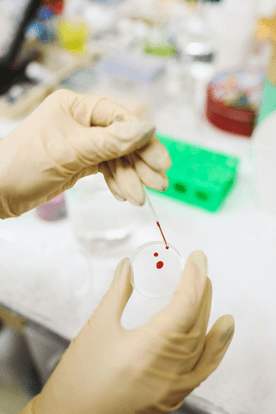
Early detection and treatment of cancer are crucial, but traditional biopsies, which involve taking tissue samples, can be stressful for children and their families. Liquid biopsies offer a promising alternative, providing a minimally invasive way to detect cancer earlier potentially. This article explains how liquid biopsies work and their potential benefits, offering a sense of relief and hope for families facing childhood cancers.
The Science Behind Liquid Biopsies
Imagine a test that uses a simple blood draw to gather cancer information. That’s the idea behind liquid biopsies. Instead of taking tissue samples, these tests analyze bodily fluids, typically blood, for signs of cancer.
The tests look for:
- Circulating Tumor Cells (CTCs): Cancer cells that have broken away from a tumor and entered the bloodstream.
- Cell-free DNA (cfDNA): Fragments of DNA released by tumor cells into the bloodstream.
Different analysis techniques, like genetic sequencing, are used to detect and analyze these markers. While the specifics are quite complex, the basic idea is to find indications of cancer in your blood, eliminating the need for a traditional tissue biopsy. Scientists use advanced techniques to analyze these markers in the blood, potentially offering clues about the presence and characteristics of cancer.
Two primary categories of liquid biopsy assays (tests) exist:
- CTC-Based Assays: These assays target the isolation and characterization of CTCs. While valuable information about tumor biology can be gleaned from CTCs, their rarity presents a challenge for detection.
- cfDNA-Based Assays: These assays analyze cfDNA fragments in the blood. Due to the higher abundance of cfDNA compared to CTCs, cfDNA-based assays offer potentially greater sensitivity for early-stage cancer detection. However, they may not provide as detailed information about the tumor itself.
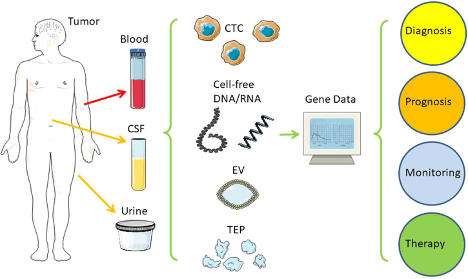 Example of liquid biopsy flow-Distant from the original tumor, blood, CSF, or urine samples can be an easily acquired and low-risk source of tumor-derived nucleic acids (RNA and DNA) for further analysis to predict and monitor tumor progression and treatment response.(Image Credit: Robert H. Eibl, Markus Schneemann. 2022. “Cell-free DNA as a biomarker in cancer” Extracellular Vesicles and Circulating Nucleic Acids. 3, no.3: 195-215. http://dx.doi.org/10.20517/evcna.2022.20.)
Liquid Biopsies vs. Tissue Biopsies
Choosing the right biopsy method for cancer diagnosis and management can be crucial. This chart explores the advantages and limitations of two key approaches: liquid biopsies, which analyze components of a patient’s blood, and tissue biopsies, which directly sample suspicious tissue. Understanding the strengths of each method can help guide treatment decisions and improve patient care.
While both procedures aim for cancer diagnosis, they differ significantly:
Early Cancer Detection
Liquid biopsies offer a groundbreaking approach to cancer detection. Because they can detect CTCs or cfDNA shed even by small tumors, they have the potential to identify cancer earlier than traditional methods. This earlier detection can lead to earlier intervention and better treatment outcomes, instilling a sense of optimism and encouragement in families.
Additionally, liquid biopsies offer the potential for:
- Monitoring Treatment Progress: By tracking changes in CTC or cfDNA levels over time, doctors can monitor how your child’s treatment responds.
- Reduced Need for Repeated Tissue Biopsies: Liquid biopsies may offer a less invasive way to monitor the disease, potentially reducing the need for repeated tissue biopsies in some cases.
FDA-Approved Liquid Biopsy Tests
The FDA has approved several liquid biopsy tests that may be relevant to your child’s specific situation. Here’s a breakdown of some of these tests, explained in a way that might be helpful for families:
- Cell Search® Test: A test that looks for tiny cancer cells circulating in your child’s blood. It can help doctors understand how aggressive certain cancers, like metastatic breast, prostate, or colon cancer, might be in your child.
- cobas® Test: Focuses on a specific part of a cancer cell’s genetic code. By looking at a blood sample, it can tell doctors if there’s a mutation that might affect how certain lung cancers (non-small cell lung cancer) respond to treatment.
- Guardant360® CDx and FoundationOne® Liquid CDx: These tests use a more advanced approach to analyzing your child’s blood. They look for a wider range of potential changes in cancer-related genes. This information can be helpful for doctors when deciding on the most effective treatment plan, particularly for cancers like lung, prostate, ovarian, and breast cancer.

Important to Remember:
- These are just a few examples, and new tests are being developed all the time.
- Talk to your child’s doctor to see if any of these tests might be beneficial for your child’s specific type and stage of cancer.
- Liquid biopsies are not a replacement for other diagnostic tests but can be a valuable tool used alongside other methods.
We understand that this can be a lot of information to process. The critical takeaway is that liquid biopsies offer a minimally invasive way to help doctors make the best treatment decisions for your child. Always discuss any questions or concerns with your child’s doctor.
Important Considerations for Liquid Biopsies
While liquid biopsies are promising, it’s important to understand some limitations:
- Not Suitable for All Cancers: Currently, liquid biopsies may not be effective for detecting all childhood cancers. However, ongoing research is actively working to expand their applicability, keeping families informed and confident about the future of cancer detection.
- Detection Rates Can Vary: The ability to detect cancer with liquid biopsies can vary depending on the specific type and stage of cancer.
- Possibility of Inaccurate Results: There’s a slight chance of false-positive or false-negative This is why doctors may still recommend other tests for a definitive diagnosis.
- Liquid biopsy cost: The cost of liquid biopsies can vary depending on factors like insurance coverage and the type of test. As technology evolves and adoption increases, costs are expected to decrease, making liquid biopsies more accessible.
If your child has been diagnosed with cancer, discuss liquid biopsies with their healthcare team. They can explain if liquid biopsies are appropriate for your child’s specific situation and answer any questions you may have. Liquid biopsies are a developing technology with great potential for improving childhood cancer management. While they have limitations currently, researchers are actively working to overcome them. This minimally invasive approach offers hope for earlier detection, potentially leading to better treatment outcomes for children battling cancer.
References and Additional Resources:
- American Association for Cancer Research- The Expanding Potential of Liquid Biopsy to Detect and Monitor Cance
- CellSearch
- Roche Diagnostics
- Guardant Complete
- Foundation Medicine
- Qiagen
- Connal, S., et al. “Liquid Biopsies: The Future of Cancer Early Detection.” Journal of Translational Medicine1 (2023): 118. Web.
- Eibl RH, Schneemann M. Cell-free DNA as a biomarker in cancer. Extracellular Vesicles and Circulating Nucleic Acids. 2022; 3(3): 195-215. http://dx.doi.org/10.20517/evcna.2022.20
- Gelineau, Noémi U., et al. “Case Series on Clinical Applications of Liquid Biopsy in Pediatric Solid Tumors: Towards Improved Diagnostics and Disease Monitoring.” Frontiers in Oncology 13 (2023): 1209150. doi: 10.3389/fonc.2023.
- Halawa, Taher, et al. “The Role of Liquid Biopsy in the Diagnosis and Prognosis of WHO Grade 4 Astrocytoma.” Cureus6 (2023): e41221. doi: 10.7759/cureus.41221.
- Liu, Zhiyong, et al. “Nanotechnology in Liquid Biopsy for Cancer Diagnosis and Therapy.” Biosensors and Bioelectronics 193 (2022): 113592. Web.
At Here To Serve, we know a cancer diagnosis can turn your world upside down. That’s why we’re here to support you and your family every step of the way. We have resources and a community of understanding individuals fighting alongside you. For more information and support, visit Here To Serve, a resource dedicated to empowering patients and their families!
Please note: This blog post is for informational purposes only and should not be taken as medical advice. Always consult a healthcare professional for diagnosis and treatment of any medical condition.